Castor Oil: The Complete Guide
At a glance (TL;DR)
- Castor oil is pressed from Ricinus communis seeds and is 85-95% ricinoleic acid.
- Used topically on hair and skin, and in measured ingestible formats: capsules and gummies.
- Choose cold-pressed, hexane-free oil; capsules skip the taste and the mess.
Quick answer: Castor oil is a plant oil pressed from the seeds of Ricinus communis, unusually rich in ricinoleic acid, the fatty acid behind most of its studied effects. It has been used for generations on hair and skin, and in measured ingestible formats. Modern capsules and gummies deliver it without the famous taste or the mess.
Few ingredients on the wellness shelf have a longer résumé than castor oil, and few are as misunderstood. It's in beauty routines and old family remedies, on ingredient labels and all over social media. This guide covers what castor oil actually is, what the research does and doesn't suggest, the difference between putting it on your body and taking it by mouth, and how to choose a quality product in each format.
What castor oil is
Castor oil is pressed from the seeds of the castor plant, Ricinus communis. What makes it chemically unusual is its fatty-acid profile: around 85-95% of it is ricinoleic acid, a fatty acid rarely found in meaningful amounts anywhere else in nature. That one molecule is responsible for castor oil's distinct thickness, its skin-conditioning behavior, and most of the physiological effects researchers have studied.
Two production details worth knowing before we go further:
- Cold-pressed means the oil was extracted mechanically without high heat, the standard for supplement- and cosmetic-grade oil.
- Hexane-free means no petroleum-derived solvent was used in extraction. Solvent extraction is common in industrial-grade oil; you don't want it in something you swallow.
One reassurance for careful readers: the castor seed contains ricin, but ricin does not survive into properly processed castor oil. The protein stays in the seed mash. Commercial cold-pressed castor oil is not a ricin concern.
A very old ingredient
Castor oil shows up in records from ancient Egypt, in Ayurvedic practice in South Asia, and in the "spoonful from grandma" tradition across half the world. None of that history is proof of any specific effect, but it explains why castor oil never left the shelf, and why researchers kept looking at it. For generations it has had two parallel lives: rubbed into hair and skin, and taken by mouth in small measured amounts.
Topical castor oil: hair, skin, and packs
The topical side is where castor oil is most famous today.
Skin. Castor oil is an effective humectant and emollient. It helps hold moisture against the skin and softens it. This is its best-supported cosmetic role, and the reason it appears in so many balms and cleansing oils.
Hair and scalp. The internet's favorite use. Honest answer: the evidence here is mostly traditional and anecdotal. Castor oil conditions the hair shaft and moisturizes the scalp, which can make hair look thicker and reduce breakage, but rigorous studies on hair growth are lacking. We'd rather tell you that plainly than oversell it. Many people pair it with rosemary oil, which has its own research story; see Rosemary Oil: Benefits, Uses, and What the Research Suggests. If you want the two together, our Rosemary & Castor Oil Blend 120mL is made for exactly that routine.
Castor oil packs. A cloth soaked in castor oil, laid on the abdomen, usually with gentle warmth. A long-standing folk practice that's had a social-media revival; formal research is thin (one small study in elderly care settings reported comfort improvements). If you enjoy packs, they're a low-risk topical ritual. Just don't expect them to do what the internet promises.
Ingestible castor oil: what the research actually says
Here's the part most articles get wrong, so let's be precise.
The one thing castor oil is officially recognized for deserves a plain mention: the U.S. FDA recognizes castor oil as an over-the-counter stimulant laxative. Ricinoleic acid interacts with receptors in the gut wall. That is a fact about the ingredient category, and it comes with a practical warning: large amounts of raw castor oil have a strong, fast effect. This is precisely why traditional use was always a small, measured amount, never a free pour.
Our castor products are not laxative products. Dr. HERBALIST Castor Oil Capsules and Castor Oil Gummies are everyday wellness formats built around a controlled, label-directed amount of cold-pressed oil. The point is a consistent, small serving, taken as directed. Follow the label and don't exceed the directed amount.
Beyond that, the ingestible research is early. Ricinoleic acid has been studied in laboratory settings for several properties, and castor oil has centuries of documented traditional use, but large human trials for general wellness outcomes don't exist yet. Where the science is young we say so. What you're buying with an ingestible castor format is the traditional practice, made consistent and convenient.*
Why capsules became the way people take it
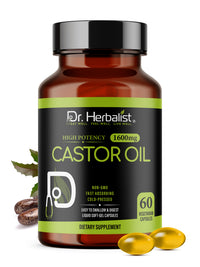
Anyone who has tasted raw castor oil knows the problem: it's thick, filmy, and famously unpleasant. That's the whole reason measured formats exist, and why Castor Oil Capsules 1600mg are our top seller:
- No taste, no mess. The oil is sealed in a softgel. Nothing touches your tongue, nothing greases a spoon.
- A measured amount, every time. 1600mg of cold-pressed, hexane-free castor oil per serving. No guessing at a pour.
- Travel- and routine-friendly. A bottle of softgels goes where a bottle of oil can't.
- Halal softgels. The full line is Halal certified.
Prefer chewing to swallowing? Castor Oil Gummies carry castor oil in an individually wrapped, no-added-sugar gummy (90 ct also available). For a full format-by-format comparison, read Castor Oil: Gummies, Capsules & Oil Compared.
How much castor oil per day?
The unhelpful-sounding but correct answer: take it as directed on the label of the product you bought. Serving size is exactly what a measured format is for. The label reflects the product's own oil content. Two firm rules regardless of format: don't exceed the directed amount, and if you're pregnant, nursing, taking medication, or have a medical condition, check with your healthcare professional before taking castor oil in any ingestible form. (Pregnancy is a specific caution with ingestible castor oil. This one isn't optional.)
Choosing a quality castor oil, whatever the format
Five things to look for on any castor product:
- Cold-pressed: mechanical extraction, no high heat.
- Hexane-free: no solvent residue.
- Single-ingredient oil (for bottles) or a short, readable ingredient list (for capsules and gummies).
- Halal certification, if your household keeps halal. Softgels and gummies are the two formats where uncertified products most often fail a halal check, because of gelatin. Our guides to halal supplements and halal gummies explain exactly why.
- A brand that answers questions about sourcing, testing, and what's in the shell, not just what's in it.
The Dr. HERBALIST castor lineup
- Castor Oil Capsules 1600mg: cold-pressed, hexane-free, Halal softgels. The top seller.
- Castor Oil Gummies (60 ct) / (90 ct): individually wrapped, no added sugar, Halal certified.
- Rosemary & Castor Oil Blend 120mL: the topical hair-and-scalp routine, pre-blended.
Browse the wider oil softgels collection, the gummies collection, and Hair & Skin for the topical side. Background reading: Castor Oil Gummies: A Traditional Staple, Made Convenient.
Frequently asked questions
What is castor oil used for?
Topically, it's a moisturizing oil for skin, hair and scalp, which is its best-supported cosmetic role. Ingestibly, it's a traditional practice now taken in measured formats like capsules and gummies.* Raw castor oil in large amounts acts as a stimulant laxative, which is exactly why measured, label-directed formats exist.
Can you take castor oil by mouth?
Yes, in small, measured amounts. That's how it has been used for generations. The taste of raw oil is famously unpleasant, so most people choose capsules or gummies. Follow the label, never exceed the directed amount, and check with your healthcare professional first if you're pregnant, nursing, or on medication.
What is ricinoleic acid?
The fatty acid that makes up roughly 85-95% of castor oil and drives most of its studied effects. It's rare in nature outside the castor seed. It's what makes castor oil castor oil.
Are castor oil capsules better than the raw oil?
They deliver the same cold-pressed oil; the difference is control and experience. Capsules give you a measured amount with no taste or mess; raw oil suits topical use, where taste is irrelevant. Our comparison guide covers all formats: Castor Oil: Gummies, Capsules & Oil Compared.
Is castor oil halal?
The oil itself is plant-derived and permissible. The finished product depends on the format. Softgels and gummies involve a shell or base that needs checking. Dr. HERBALIST castor capsules and gummies are Halal certified.
Does castor oil grow hair?
The honest answer: strong clinical proof is lacking. Castor oil conditions hair and moisturizes the scalp, which can reduce breakage and improve how hair looks and feels, but claims of regrowth outrun the research. Many people combine it with rosemary oil, which has its own studies on scalp health.
*These statements have not been evaluated by the Food and Drug Administration. This product is not intended to diagnose, treat, cure, or prevent any disease.